
WIL Weekly #62
Glyphosate, Humming, Heat as a hunger suppressant

This is my free weekly newsletter covering 3 interesting points from the week. Subscribe (if you haven’t already) if you’d like to get it in your inbox each week!
Hot food fills you up more than cold food
For the longest time I’ve recommended hot water among the list of strategies to keep energy up and hunger down during longer fasts. It’s been hard finding a specific mechanism to point to, but it just works. Walking is my go-to thing to keep energy up and hunger at bay while fasting, but sometimes I need to sit and work at a computer for a couple hours. Depending on the day of the fast it’s not that big of a deal, but drinking something hot - even water with nothing in it does a lot to keep you feeling good.
A May 2024 paper describes the effects of having 13 people consuming three different types of meals (high carb, high fat, high protein) at three different temperatures (cold, warm, and hot) in a randomized, controlled crossover design. They looked at plasma concentrations of hormones associated with satiety - GLP-1 and CCK.
A comparison of the three meals at the three temperatures (total of nine groups), showed that the… GLP-1 and CCK responses increased more after hot meals than cold meals. Overall, high-fat meals had more effective gut hormone secretions. The area under the curve was increased for GLP-1 in high-fat meals and for CCK in hot meals. The peptide hormones (GLP-1 and CCK) were positively correlated with satiety scores…
They concluded that “Hot food temperature increased satiety hormones (CCK and GLP-1), independent of food macronutrient composition.”
Humming isn’t just for babies

While trying to figure out how to calm down my fussy 3-month-old nephew, I realized that simply humming with no particular melody was just as effective as my singing to him. Of course what was more effective was his Mom singing to him. While lamenting his impending sleepiness, he would sometimes ‘sing’ along with her, but it came out like a barely melodic hum: ‘uhhh-uh. uhhh-uh. uhhh-uh.’
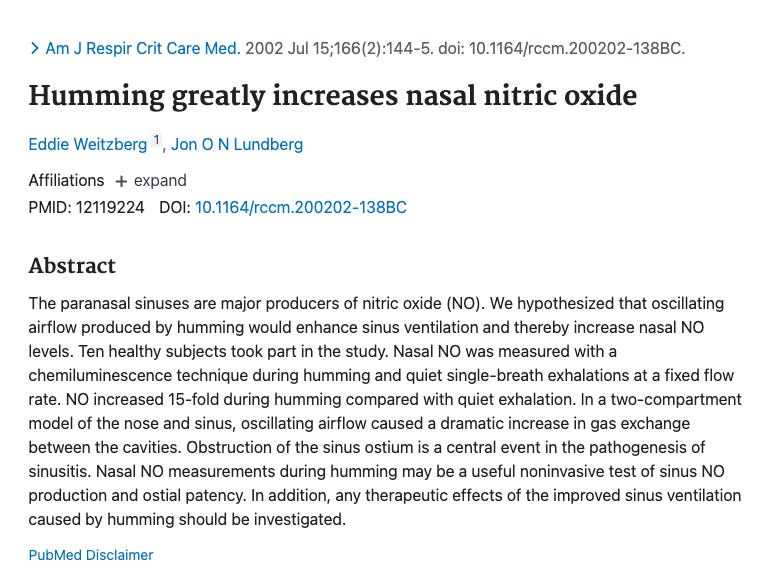
This might be because he read the 2002 paper finding that humming greatly increases nitric oxide. The paper documented that nitric oxide increased 15-fold during humming compared with quiet exhalation.
A 2023 paper found that humming ( ‘bee breathing’ ) was a more effective stress reliever than physical activity or stress based on heart rate variability data.
Humming (simple Bhramari) can be an effective stress-buster based on the assessment of several HRV parameters during its practice and in comparison with other activities. A regular daily humming routine can help enhance the parasympathetic nervous system and slow down sympathetic activation.
This Bhramari technique is done as follows:
Sit up straight in a quiet, well-ventilated corner with your eyes closed. Keep a gentle smile on your face.
Keep your eyes closed for some time. Observe the sensations in the body and the quietness within.
Place your index fingers on your ears. There is a cartilage between your cheek and ear. Place your index fingers on the cartilage.
Take a deep breath in and as you breathe out, gently press the cartilage. You can keep the cartilage pressed or press it in and out with your fingers while making a loud humming sound like a bee.
You can also make a low-pitched sound but it is a good idea to make a high-pitched one for better results.
Breathe in again and continue the same pattern 3-4 times.
Glyphosate wrecks the entire body
9 years ago, Canadian scientist Patrick Moore famously said that “you can drink a whole quart of [glyphosate] and it won’t hurt you.” When the interviewer he was speaking to said that they had some for him to drink, he said “I’d be happy to actually- Not, not really, but I know it wouldn’t hurt me.” When reiterating that they really do have some for him to drink he said “No, no, I’m not stupid.” He then followed that up by saying that people try to commit suicide with it and fail - “fail regularly.” The interviewer pressed again, asking if he was ready to drink a glass of it. Moore said “No. I’m not an idiot.”
In 2021, with rapid and aggressive intervention, a 69-year old woman who drank the equivalent of 200ml of glyphosate in a suicide attempt, in fact, survived. Though, she was far from unharmed. She was left ‘critically ill,’ and more specifically:
…developed respiratory distress needing intubation, hypotension needing vasopressor support, and severe lactic acidosis. She also developed acute respiratory distress syndrome, hypokalemia, hypernatremia, and aspiration pneumonia. Our patient was critically ill with multiple poor prognostic factors, but with timely aggressive supportive management, the patient gradually recovered.
The authors of the case report conclude “this case report emphasizes that glyphosate poisoning could be life-threatening. There is no antidote for this herbicide poisoning.”
Patrick Moore was indeed correct that if he were to drink it, he would have been a stupid idiot.

Glyphosate, the most commonly used pesticide since 2001, is heavily and routinely used throughout the United States. Should we be worried about the (relatively) small amounts of glyphosate that have made it to tons of the foods in our food supply?
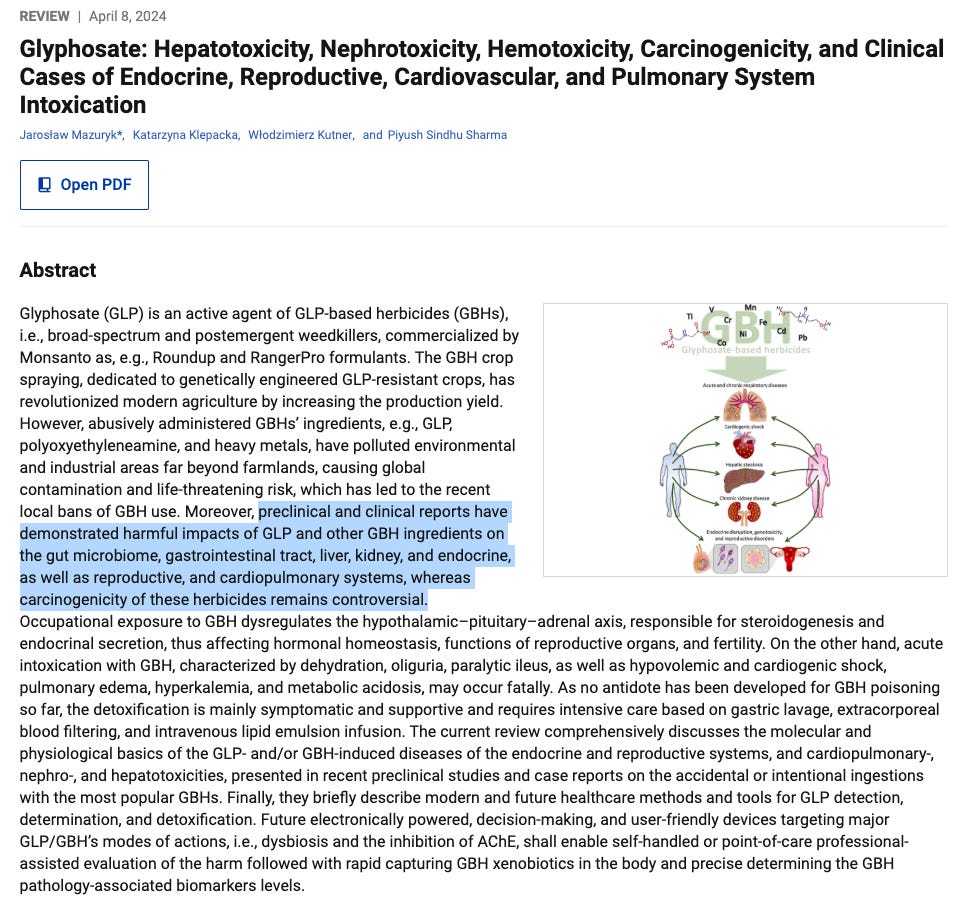
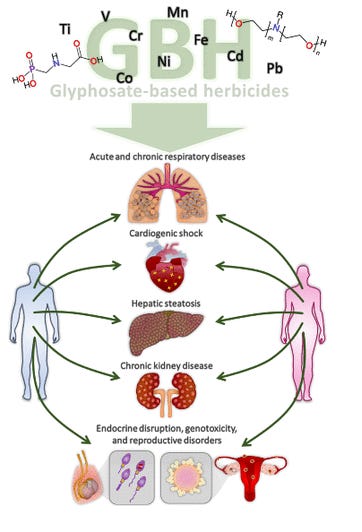
Considering an April 2024 review highlights that it is “remarkably poisonous to the gut microbiome and the neurological system” and is toxic to the liver, kidneys, blood, lungs, endocrine system, reproductive system, cardiovascular system and is cancerous, I’d avoid it as much as is practical.
‘Officially’ the amount of glyphosate that ends up in your food is safe because it’s under residue limits.
Yet, a 2017 paper out of the University of Massachussetts called this into question and states that:
We conclude that current safety standards for GBHs are outdated and may fail to protect public health or the environment.
Before that, in 2016, a consensus statement paper out of Carnegie Mellon University also concluded that:
Regulatory estimates of tolerable daily intakes for glyphosate in the United States and European Union are based on outdated science.
Humming (as well as singing, gargling, deep breathing, massage and more) stimulates the vagus nerve, which in turn has a relaxing effect through activation of the parasympathetic nervous system. Release of nitric oxide lowers blood pressure too. Joseph, your nephew sounds beyond-adorable :)
Funny how I always drink warm water and it weirds out people 99% of the time, for some reason. I just prefer it as it always made me feel personally better compared to cold, lol.