
WIL Weekly #63
Red light rejuvenates the skin, Lack of sleep causes more intrusive memories, atheists

This is my free weekly newsletter covering 3 interesting points from the week. Subscribe (if you haven’t already) if you’d like to get it in your inbox each week!
Red light rejuvenates the skin?
I was doing some editing today on an interview I did last summer and thought that my skin looked much better than it does now. I had a good tan, but even with that considered I think it looked much more healthy. This is pretty interesting considering the constant sun exposure I was getting should have wrecked my skin and given me melanoma.
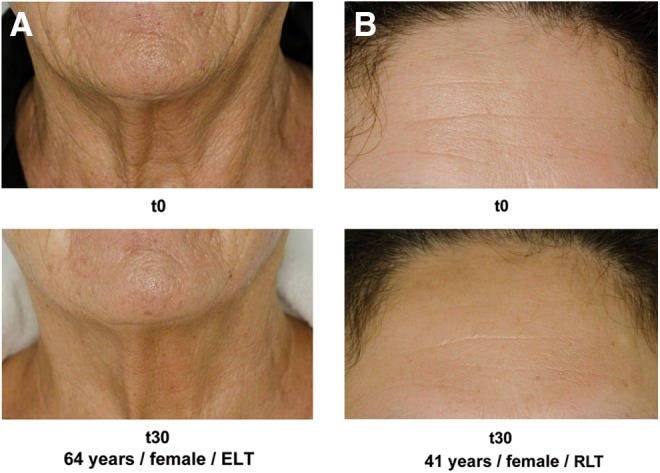
A February 2014 paper had 136 volunteers participating in a randomized, controlled study to see the effect of two photobiomodulation (red light) sessions per week for 30 treatments total. This had a dramatic rejuvenating effect on their skin:
The treated subjects experienced significantly improved skin complexion and skin feeling, profilometrically assessed skin roughness, and ultrasonographically measured collagen density. The blinded clinical evaluation of photographs confirmed significant improvement in the intervention groups compared with the control.

Lack of sleep leads to more unwanted memories
December 31st, 2024 paper: Memory control deficits in the sleep-deprived human brain
Sleep disturbances are associated with intrusive memories, but the neurocognitive mechanisms underpinning this relationship are poorly understood. Here, we show that sleep deprivation disrupts prefrontal inhibition of memory retrieval, and that the overnight restoration of this inhibitory mechanism is associated with time spent in rapid eye movement (REM) sleep. The functional impairments arising from sleep deprivation are linked to a behavioral deficit in the ability to downregulate unwanted memories, and coincide with a deterioration of deliberate patterns of self-generated thought. We conclude that sleep deprivation gives rise to intrusive memories via the disruption of neural circuits governing mnemonic inhibitory control, which may rely on REM sleep.
The above abstract is quite straightforward, but the 2024 study found that sleep deprivation makes it harder for the brain to prevent intrusive memories. Specifically, they noted that more time spent in REM restores the ability to prevent intrusive memories. They even note that a lack of sleep coincides with “deterioration of deliberate patterns of self-generated thought.” Less sleep meaning less control of your thoughts reminds me of my 7-year-old video Why we don’t have Free Will & Why that’s OK.

Mascots for Atheisms’ lies
Recently, I decided to do something about the fact that I’m quite ignorant about Christianity. I never really learned that much about it, but I had read Richard Dawkins’ The God Delusion and Sam Harris’s The Moral Landscape more than a decade ago and watched plenty of Christopher Hitchens.
Recently, I’ve written a fair amount about Buddhism, which I had in fact more or less dismissed when I was younger. I mostly saw it as something like an ice bath with a bunch of stories surrounding it. That is, I acknowledged there are concrete physiological and mental benefits to meditating so I figured you could simply meditate, get the benefits, and skip all the philosophizing. After taking the time to do a more serious investigation of Buddhism and its different schools, I found it to be far more rich and valuable than I had given it credit for.
I may have been to church a couple times when I was very young, but I have almost no memory of it. I had never read the Bible or seriously considered much of the content of Christianity likely because pop culture and surface-level arguments from people like Richard Dawkins had a young me believing that it was case closed: to be intelligent, you can’t take Christianity seriously. The ignorance of that conclusion is highlighted by the fact that people like the father of modern genetics, Gregor Mendel, the man who proposed the Big Bang theory, Georges Lemaître and the leader of the Human Genome Project, Francis Collins all believed in Jesus Christ.
I’ve only been reading about Christianity for about a month or so, but its far more interesting than I had assumed. (This is discussed in some more detail in my post What if it’s all a big Placebo?)
In my above Why we don’t have Free Will video, I had included a clip of Sam Harris, someone whose claims about religion I was influenced by, but never investigated. 15+ years ago, Sam Harris criticized Jesus in a presentation of his, saying that according to Luke 19, Jesus says “anyone who doesn’t want me to reign over him, bring him before me and slay him before me.” Except… when Jesus said this he was telling a parable and quoting the words of a king (The Parable of the Ten Minas). The “slay them” part is from Luke 19:27 with the parable starting in Luke 19:11. You don’t even need to go back to Luke 19:11 to realize this. Sam Harris’s thorough investigation didn’t even last long enough to see that there is a quotation mark right at the end of Luke 19:27.
Richard Dawkins wrote in page 121 of his book The God Delusion that “it is even possible to mount a serious, though not widely supported, historical case that Jesus never lived at all.” Dawkins was pressed on this point by professor of Mathematics at Oxford University, John Lennox, Dawkins said “I don’t think it’s a very important question whether Jesus existed.” Then, he quickly conceded, saying “I take that back. Jesus existed.” Too bad this happened 18 years after The God Delusion was published.
Timing is a funny thing- Just yesterday, Christian apologetic and expert on the history and transmission of the biblical texts, Wesley Huff appeared on The Joe Rogan Experience.
Historian Wesley Huff explained on Joe Rogan that there is plenty of evidence for Jesus’s existence outside of the Bible.
“if you look at, say, very skeptical biblical scholars, like non-believing atheist agnostic Christian scholars, they will say, if we can know anything about Jesus, they’ll cast a doubt on a lot of the things that we read about in the gospels in terms of the actual historical Jesus of Nazareth. They’ll say one thing we can be sure of is that he died by crucifixion under Pontius Pilate because we have not just multiple attested documents that we refer to as the New Testament, but Roman and Greek and Jewish writers refer to that claim afterwards and talk about the fact that you have this guy and it’s mocked within earliest Christianity.”
Not only that, he explains that there is as much historiographical evidence for the existence of Jesus as there is testimony of the life of the Roman Emperor Tiberius, who had four personal biographers.
“The interesting thing about Jesus is that we have more evidence from different writings in the ancient world than we probably should have for someone of his stature. Because we have Matthew, Mark, and Luke, and John, these four biographies.
There’s really only one other person in and around that time that can claim to have that much kind of independent testimony of their life, and it’s the Roman Emperor Tiberius. So, he has… he also has four biographers. He has Cassius Dio, Suetonius, Tacitus, and Velleius Paterculus. And so, the Roman Emperor, who’s the most famous, most powerful person at the time, has a similar amount of historiographical evidence, biographically, for his, you know, the events of his lifetime that Jesus does.”
It is very interesting to me to see the fall of the whole "New Atheism" scene. Richard Dawkins was never very deep. Sam Harris was always pretentious and has subsequently gone borderline nuts politically and from covid. Christopher Hitchens was the only one who seemed genuine in his arguments and with his death, the whole movement kinda fell apart.
The best contrast between Christianity and Atheism is in a good documentary called "Collision" which followed Hitchens as he traveled and debated Doug Wilson. Wilson and Hitchens had a lot in common intellectually and were actually friends but the fruit of their religious presuppositions come out when they're home. Hitchens, alone with his books, contrasted by Wilson surrounded by family and singing together.
I've followed you for about 5 years and have massively benefited from your fasting, seed oils, and protein related content. Especially fasting as I have now implemented bi-yearly long (5-7 days) fasts and have seen tremendous improvements in my immune system, gut health, mental clarity and focus, and confidence in long term anti cancer likelihood.
I'm really encouraged to hear you're investigating Christianity. Health related knowledge is valuable in this life but as Jesus said, "For what does it profit a man to gain the whole world and forfeit his soul?"
If you're interested, I'd recommend reading Cold Case Christianity by J Warner Wallace. He is a 3rd generation detective who grew up as a hard atheist. When he got tired of people trying to convince him of the resurrection of Jesus he decided to apply his cold case detective skill set to finally prove them wrong. It was during his investigation where he became utterly convicted that Jesus did in fact rise from the dead basis on all the evidence.
Some other random thoughts...
Fasting is such a common practice in the Bible as prescribed by God. How wise of Him to prescribe something so beneficial to humans way before we had the science to study and understand it's benefits.
Prayer and meditation go hand in hand. If anything prayer has a leg up on the 'simply empty your mind' kind of meditation since prayer often has you focus on thankfulness which has been shown to greatly improve your well-being.