
Stop trying to know yourself so hard
The data suggests you can only know so much about your mind. Here's why this is good news.


“I dare you to take your shoes off!” said one of the girls. The three of them all giggled. Then… to everyone’s surprise… One of them actually did it. No way. Can you believe that? Mild-mannered Cindy of all people had the absolute gall to remove her shoes in the middle of an outdoor gymnasium. Wouldn’t this affect her jump roping? The group of girls burst out in laughter.
Another girl decided to up the ante: “I dare you to take your socks off!” They burst out into giggles again.
The gymnasium was filled with three-person groups of second graders jumping rope. My group happened to be right next to these wild pranksters.
I found the girls annoying. I was sure my fellow eight-year-old team members did too. Maybe I thought the giggling wasn’t warranted; maybe it was because they were better at jump rope than us; maybe I was jealous that they got along much better than I did with my group; maybe I actually liked one of those girls but consciously acted as if I disliked her a la Freud’s concept of “reaction formation.” There was probably a good reason. In any case, I thought I should make fun of them.
Being a master logician, I decided I would reveal to the girls the folly of their game. Taking their dare game to its logical conclusion would make them the laughing stock of the whole school. The game could not continue. In a Spongebob meme-like sarcastic tone, I shouted: “I dare you to take your pants off!”

My zinger got some chuckles from the guys. However, the girls’ giggles completely stopped. They all had this open-mouth expression of ‘oh no you didn’t.’ Tough crowd.
Cindy dropped the jump rope said “I’m gonna tell coach.” She promptly walked over to the female coach overseeing jump rope day. Even though she was halfway across the gymnasium I could see Ms. Coach’s expression morph from a smile into grave concern. Cindy had this look of “Hah. You’re in trouble now.”
The gymnasium suddenly seemed colder and my neck hotter. I dropped the rope so I could bite my fingernails better.
I hadn’t said a bad word. I hadn’t punched or kicked her. I had merely followed the logical sequence of shoes to socks to pants. It turned out that Coach didn’t think my zinger was funny either. She used her most powerful form of punishment: sending me to the principal’s office. Pleading that I was “just joking” did not help.
I can’t totally remember the discussion with the principle, but I remember being slumped in a chair with a mix of embarrassment and frustration. No, I didn’t actually want anyone to remove their pants. Why couldn’t he understand that I was just trying to get a laugh from my jump rope team at the girls’ expense?
The principle escalated the punishment: telling my parents. The discussion with my Mom after school in the car wasn’t any better than the one with the principle.
No, my second-grade self was not interested in those girls, nor the contents of their pants. It was just a joke. What was I feeling when I said it? I don’t know, anticipation of laughs? There’s gotta be a German word for it. I took a chance at being funny and blew it.
Little did I know, this event would be the spark for my life long hatred of being misunderstood. This is why my Youtube videos are so thorough. I always feel the need to over-explain things because I can’t bear being misunderstood.

Or wait… maybe the reason I don’t like being misunderstood because of the time the substitute teacher chastised me for cheating at Monopoly? I said I liked to stash a $500 under the board so people thought I had less money than I did. She thought I meant steal a $500 from the bank and stash it for myself.
“That’s cheating Joseph, you can’t steal money from the bank.”
“No, I mean I would take one of my own-”
“Even if it’s just a board game, cheating is wrong.”
Except… nobody likes being misunderstood. There is also absolutely no shortage of people who like explaining stuff (perhaps guys more so than women).
The main thing I remember concluding from the pants incident wasn’t something about how to tell better jokes. I concluded Cindy didn’t like me, so she made the coach think I was actually being serious. Moral of the story that my eight-year-old self came up with? Cindy is a jerk.
We all remember consequential moments in our life where the meaning of the event is clear. Though, did this pants incident have a consequential impact on my unconscious? I don't think I can know that.
How much of your mind can you really dig up?
We’re actually pretty bad at understanding ourselves. Is the reason you’re always doomscrolling and watching because a particular event in your life left you consumed with existential dread? Did something happen that made you think you’re in need of a psychedelic-induced spiritual experience in the Amazon? Or, have you just gotten in the habit of relieving every little moment of boredom with a couple scrolls on Instagram?
While I don’t know what goes on in your head, taking your phone into the bathroom every time you need to take a dump for years may have told your brain something about boredom.
Are the parts of your brain that house the specific reasons why you came to act the way you do actually accessible?
This of course is the promise of psychoanalysis: that a professional will unearth the contents of your subconscious and these revelations will resolve your problems.
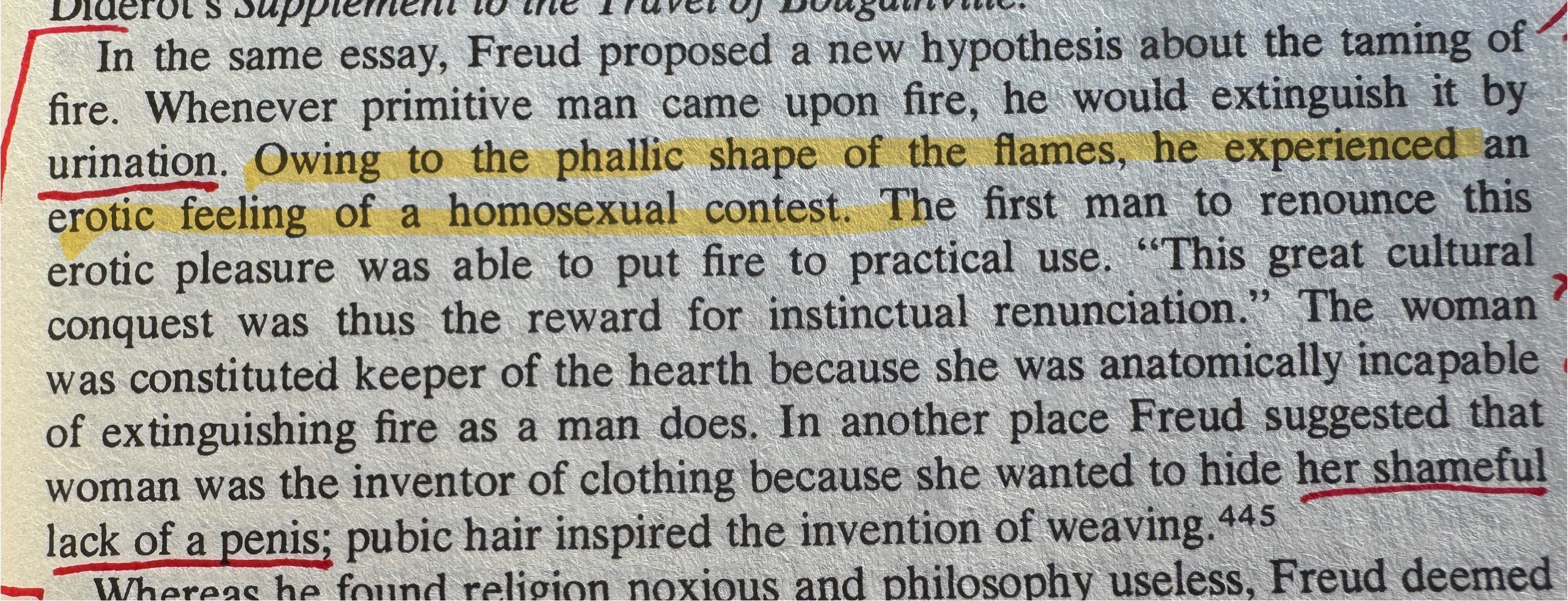
Freud had some great ideas but he also was kind of a pervert. If you’re a hammer, everything looks like a nail. To Freud, everything looked like sex. He had all sorts of unique ideas like that man learned to control fire by controlling his homoerotic enjoyment of peeing on fires, that a cause of paranoia was repressed homosexuality, that women invented clothes to hide their shameful lack of a penis, that pubic hair inspired the invention of weaving, and of course that wanting to have sex with one’s mother and kill their father was a universal male experience. Freud also attributed neurotic symptoms to the repression of painful memories, usually sexual ones.
I wonder how Freud would have squared the fact that eight-year-old Joseph enjoyed the allegedly homosexual activity of peeing on fires yet it was Cindy, not one of my male classmates, that I dared to take their pants off.
What many people don’t know about Freud is what he admitted about the unconscious. He said we can’t really tell what is an actual, consequential memory unlocked from the unconscious and a complete fiction. In a letter to his best friend Wilhelm Fliess in September 1897, he said
“In the unconscious there is no sign of reality, so one cannot differentiate between the truth and the fiction invested with feeling.”
In fact, Henri F. Ellenberger reveals in The Discovery of the Unconscious that the patient Anna O. who famously inspired Freud’s psychoanalysis was not, in fact, cured. Freud’s mentor Joseph Breuer had Anna discuss her past which lead her to revelations about the causes of her issues. Except, Carl Jung revealed in a 1925 seminar that Freud told him that this cathartic treatment had not actually cured Anna O.
The power of Insights
Turning on the light-bulb moment epiphanies and insights feel great. The delightful feeling of surprise comes with the confidence that the insight must be true. The thing about the insightful ‘Aha!’ moments is that they still feel good even if they’re wrong. You can see this process happen multiple times during a game of charades or Pictionary.
“Oh! I’ve got it! It’s a giraffe!”
“What? Not even close.”
“Oh.”
In 1988, therapy sessions gradually revealed to Meredith Maran the utterly shocking contents of her subconscious. The enlightening process dug up a repressed memory that had been tucked away for decades. This lead her to finally revealing to her family what may have been at the root of her strained relationship with her father.
He had sexually abused her.
Faced with Meredith’s shocking and bewildering accusation, her family was forced to choose sides— believe her, or believe her father who vehemently denied the accusation.
She didn’t speak to her father for eight years after the secret came out.
Meredith did not have a good track record as far as relationships with men goes. Several of her romantic relationships, including a marriage, had utterly failed for her. As for her relationship with her father, she described him as having been “alternately neglectful and intrusive, distracted and authoritarian, absent and self-absorbed.”
In the early 80’s she became a radical feminist and was investigating childhood abuse. Not only had she been dealing with horrific tales from abuse survivors for years, she was now dating a woman who was herself an incest survivor.
Meredith was a reporter covering the “recovered memory” phenomenon sweeping the United States. Along with her research and her relationship to an incest survivor, she was also teaching a women’s writing class where nearly every student was writing some sort of sexual abuse memoir. Meredith said she was living on “Planet Incest.”
Meredith received a copy of The Courage to Heal, a wildly popular book that she said “led many to think of themselves as abuse victims.” Meredith started having nightmares about her father molesting her. The people around her told her not to doubt the visions.
In 1996, Meredith finally realized herself that the sexual abuse had all been completely imaginary.
She came clean and apologized to her family for being so influenced by her circumstances that she conjured up this false memory. She apologized for all the damage it had done.
During the 1980’s and 90’s, the recovered memory movement was in full swing. Several factors including ‘repressed memory therapy’ lead many adults and children to believe they were victims of sexual abuse. Some cases were accurate. However, there were many cases where the memories in fact turned out to be completely fake, despite the person initially being so confident.
The False Memory Syndrome Foundation was founded in 1992. The purpose of the foundation is to “seek the reasons for the spread of false memory syndrome, to work for ways to prevent it, to aid those who were affected by it and to bring their families into reconciliation.”
Memory researcher Elizabeth Loftus explains that contrary to popular belief, memory is not a perfect recording of the past. It’s a reconstructive process. At a family gathering, 44-year-old Loftus’s uncle mentioned she had been the one to discover her mother’s body after she drowned in a pool over 30 years ago. Her uncle’s words unlocked something in her mind. “Until then, she remembered little about the death itself, suddenly the memories began to drift back, clear and vivid.”
A few days later her brother told her that her uncle said he had made a mistake. Loftus’s aunt was the one who had found her mother’s body, not her.
Your mind is not an objective bookkeeper. It’s not an unbiased judge. It’s not your fucking khakis.
Our minds are just winging it
In Psychologist Dr. Timothy Wilson’s book Strangers to Ourselves: Discovering the Adaptive Unconscious, he thoroughly lays out how looking inwards to understand our hidden motivations and desires is often more a process of creation rather than discovery.
His main point is that being honest about what our behavior reveals is the most effective way to understand ourselves. While it may feel like it, the mental conversations we have with our inner narrator aren’t always that truthful.
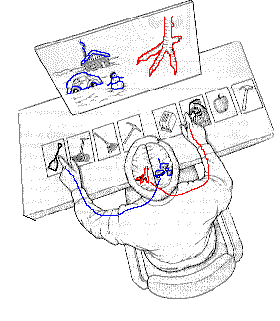
A great example of the brain’s tendency to make shit up comes from split-brain patients. The corpus callosum of these people has been severed. This means their left brain is disconnected from the right brain. The two halves of the brain can’t communicate. This leads to all sorts of weird phenomenon like being able to solve certain puzzles but unable to explain why.
For example, you could show the left eye a snow scene while the right eye saw a chicken foot. The left hand would point to a snow shovel while the right hand pointed to a chicken face. Remember, the language side of the brain is disconnected can’t communicate with the part of the brain processing the snow scene. This means the reason why they correctly picked the shovel is inaccessible to the part of the brain that can explain that. So, the people would just make something up:
“Of course a chicken foot goes with the chicken, and if you’re going to clean out a chicken shed, you need a shovel!”
Psychologist Dr. Dan McAdams argues that our identities are mostly formed by us telling an ever-evolving story about our past, present and future. A fair bit of rationalization needs to take place for the story to make sense.
Human psychology, behavior and values are riddled with contradictions. The purpose of our evolving self stories is to make a coherent narrative out of conflicting information. McAdams argues that our life stories do not and need not correspond perfectly with the actual external reality.* They are as much of a dramatization of our personal histories as Mel Gibson’s The Patriot is of the events in 1776 America.
*Of course, our personal stories are mostly based in reality. Otherwise, you may have Schizophrenia.
If I was a comedian, I might think about that 2nd grade story as an important lesson about jokes.
We could get a bit more creative and say the pants experience lead a frustration with authority figures which is why I became an entrepreneur.
Maybe I’m criticizing Freud in this article because the embarrassing car ride with my Mom felt like some kind of psychotherapy session.
Whatever we go with, it would be a story. Maybe an interesting one, but an unverifiable one.
Dr. Wilson also notes that we aren’t the best at even accurately predicting what has the biggest effect on our own moods day to day.
He conducted a study where they asked college students to keep track of their moods every day for five weeks. They also rated several things that might affect mood like weather, the quality of their relationships with friends and sleep. They then painstakingly computed the precise correlations between these variables and their mood. They also asked the students themselves how much they thought each variable affected their mood.
What made this interesting was they also asked a separate group of complete strangers to judge the relationships between the variables and the daily moods of the students. They were given no extra information whatsoever about the students.
It turned out that the students themselves and the strangers both correctly predicted how important relationships were for mood, but both incorrectly predicted the importance of sleep on mood.
The complete strangers were just as accurate in their predictions about what affected the students’ mood as the students themselves. Wilson writes:
The tremendous amount of information the participants had about themselves—their idiosyncratic theories, their observations of covariation between their moods and its antecedents, and their private knowledge—did not make them any more accurate than complete strangers.
Wilson also reports on several other experiments like asking people to give reasons why they preferred one type of panty hose to another. People might say something about the feel of the fabric, how stretchy it was an so on, but what the data showed was that the simple placement of the panty hose was a big predictor of preference. People usually preferred panty hose that was placed on the right side of the table yet no one correctly identified this as the reason why they picked it.
If the woman at the bar asks why you chose to talk to her of all women there, you probably shouldn’t say because she was on your far right.
Another interesting example he gives is that of the famous hot-girl-on-a-bridge experiment. (Presumably grinning) researchers had a very attractive woman equipped with a clipboard ask men various questions about scenic attractions effect on people’s creativity. This took place in a park in British Columbia which had a scary foot that went across a deep gorge. The woman approached men in two conditions. One was in the middle of the bridge that was shaking in the breeze. The other was when they were already resting on a park bench after crossing the bridge.
After asking the questions, she would tear off a piece of the page, write her number down and say they could call her if they had any questions. The researchers wanted to see how many of the men would be attracted enough to call her up and ask her on a date.
It turned out more than double the men on the bridge asked the woman on the date versus the park bench. 65% of the bridge men asked her out, but only 30% of the bench men did.
The conclusion was that the men were confused about their bodily signals. The bridge jacked up their heart rate, made them sweat and made them short of breath. They mistook this for being absolutely smitten by her.
This is why first dates should always be on a roller coaster during a hurricane while both people are on amphetamines.
Dr. Wilson’s book is filled with examples of why it’s difficult for us to know exactly why we make the decisions we do, why certain things upset us, why we have the values we do and so on. Even when you think you’ve got a good guess, the rationalization machine that is your brain won’t always give you an accurate, unbiased explanation.
As someone who tends to over-analyze everything, I find this to be very freeing. There are limits to introspection so don’t overdo it.
At some point you have to say who cares, fuck it
A couple years back, I ran into someone I had met through work an even coupler years back. He was about my age and a fun guy to talk to. I always enjoyed meetings with him. At the party, my friends and I were having a good chatting with him, but his expression suddenly changed when I was explaining how he and I met. Within about 10 minutes he said he had to go.
At some point he sent an angry text to my friend specifically naming me as an arrogant asshole. My friend showed me the text. He and I both agreed it was bizarre and we had no idea why he was acting like that.
I said I would text him. My friend said “Who cares. Fuck him.” I still texted the guy.
Long story short, it turned out that he completely misinterpreted an English jargon that we often used at my job at the time. I explained the actual meaning of that word and that I certainly didn’t mean what he thought. I thought we’d have a laugh over the misunderstanding. Instead, he was as immature as he was at the party. He insisted I was still in the wrong, saying I should have known that that word would piss him off. I politely ended the conversation thinking “yup, fuck this guy.”
I told my friend about the follow-up. He said the same thing. “Who cares. Fuck him.”
The point is, his immaturity was already sufficiently apparent from the first interaction. None of the people in the group were familiar with the jargon either yet they had absolutely no idea what could have offended him. It’s not like I dared him to take his pants off.
I could have saved myself a lot of time and annoyance by going with my gut feeling and not trying to dig further to figure out the specific reason for his behavior.
This is your story. Make it a good one.
“This is it. This is your story.”
—Auron
Over 6 years back when I was living in a different part of Tokyo, I got really into trying to understand myself and my psychology. I was reviewing all my life events and what impact they had on my personality and values.
Though, if I’m honest, I’ve always been interested in psychology. What makes people tick is exciting, but I’ve also spent countless hours investigating the reasons my mind works the way it does. Like some kind of speedrunner trying to shave 15 seconds off their Super Metroid run, I figured if I could see the game code, I could hack my way to better performance.
If I knew the “root” of my issues, wouldn’t that be the key to solving them? Why was I always fighting with procrastination?
At one point I did some work with a therapist. It got a little tiring when it felt like I was working with a ghostwriter. ‘If we can get a tearjerking scene in this chatper, the book will perform at least 20% better. What about that incident with your cousin?’ I was wondering if him trying to coax me into crying would really help with procrastination. I probably needed to search for a different therapist, but I procrastinated on doing that.
I had become very impressed by Dr. Gabor Mate’s work and it didn’t take long to learn that the message was that most people’s problems were caused by trauma. Mate claimed that “someone without the marks of trauma would be an outlier in our society” and that “Trauma is underneath all human dysfunction,” which includes everything from ADHD to addiction.
“You can wound a kid not only by doing bad things to them, but by also not meeting their needs,” he says. At this point, I wasn’t aware that the bar for trauma was so low.
Maybe with enough introspection, I could find out what my ‘trauma’ was. After all, everyone must have it right? Were my ‘needs’ not met?
“Understanding is the recognition of pattern as such.”
—Alfred North Whitehead
My frequent introspections quickly became flavored with self-pity.
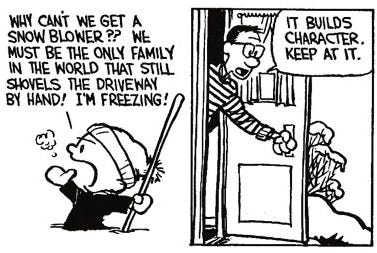
One of the fruits of this exercise was sending an angry email to my Dad for having me do a job for his business over the summers. While my friends were either relaxing playing video games or out at the beach, I was stuck doing manual labor from morning until evening.
The only thing worse than hours of lugging 45 pound crates around in the Texas heat while cicadas are yelling at you is tipping over a wheelbarrow filled with 45 pound crates.
Those strong feelings of frustration and disappointment I had to experience in my formative years surely had an impact on my psyche.
Maybe that was why I would procrastinate so often. I’ve internalized my ‘slave driver’ Dad into my mind and so when that slave driver portion of my psyche tries to force me to work, I fight back. I try to claw back some kind of freedom from the slave driver and waste my time doing some irrelevant, low-priority task like organizing video files on my external hard drives.
Hey, that’s an interesting story. I just came up with that right now even though it’s 4:30AM and I’m struggling with post-Europe jet lag. Not bad.
At the time, I didn’t think of myself as a lazy teenager. I always left my homework and studying until the last minute, and when I did study, I would only do enough to get myself a B. I probably even patted myself on the back with a mental justification of: “I’m so smart, I can get everything done at the last minute and still get a B.”
Luckily, my Dad only had my behavior to make an assessment. He correctly deduced that the remedy for my complete lack of work ethic was… a lot of hard work.
Long days of cursing at pulley systems and lugging crates back and forth all day is not exactly something High Schoolers sign up for. However, finally completely filling an elevated platform up with all 25 crates is pretty damn satisfying. Also, dinner always tastes better when you’re exhausted.
Is this why one of my favorite games is Death Stranding where you’re basically just lugging boxes from one place to another for hours? Dr. Maguire, I think we’ve made a breakthrough.
It didn’t take me long to follow up that first email to my Dad with another email apologizing for trying to act like I was some kind of victim. I thanked him for the summer job as well as other tough projects I participated in. It was exactly what I needed.
I realized that yea, I might procrastinate on writing by overdoing my research, but I have a pretty damn good work ethic. I sometimes waste time trying to come up with the perfect angle for a topic, but when I know what I need to do, 12 hour days and all nighters are easy. I wonder where I could have possibly got that from.
I could probably make this section more interesting by having a look at what I wrote in my email to my Dad, but I’ll spare myself the embarrassment.
The whole point is: I thought more and more digging into my mental headspace would lead to more and more insight and therefore more and more tools to improve myself. However, one of the side effects was constructing stories that just made me more frustrated and less grateful.

The more frustrated you are you with yourself, the more a mental life review is going to reveal the frustrating aspects of your life. Sometimes it may seem like a good idea to go digging around in your big box of lego pieces after eating a bunch of Pillsbury toaster strudels. Just don’t blame LEGO for your weirdly shaped lego car being sticky and greasy.
Some level of introspection is of course good. Casting out all self-reflection is a terrible recipe for both a mirror company and a good life.
However, there are portions of your mental code that you’ll never access to. Also, that software you downloaded off of Limewire to read the code? It might be just making things up. You’ll just have to speed run the game the good ol’ fashioned way. Try things and stick with what makes you satisfied with yourself.
The more you learn about the limitations of our conscious mind’s ability to fully grasp why we do what we do, the lighter you’ll feel.
In Strangers to Ourselves, Dr Wilson cites evidence that too much introspection can actually be counter productive. He makes the case that if you want to know who you are, step out of your mind and just pay attention to what you actually do. Then, try and learn what other people think about you.
If you want to change yourself for the better, you have to just do different things. Often when we want change for ourselves, we also want to change how other people think of us. Considering people can only judge you based on your behavior, the solution for both is the same.
Many people get trapped focusing too much on what’s going on inside because they think it’ll improve their behavior. The reality is that it’s often faster to change how your mind works by changing your behavior patterns first.
Causes or goals? Pick a psychology
“I am not what happened to me, I am what I choose to become.”
-Carl Jung
A large chunk of the foundations for our modern psychology came from Freud. Freud got many of his ideas about psychology from Jean-Martin Charcot and Pierre Janet. Before that, an Austrian physician named Franz Anton Mesmer was trying to heal people's issues by manipulating "animal magnetism," a fluid coursing through the human body. His mesmerizing people with magnetic techniques laid the groundwork for hypnosis. Going back farther, there were all kinds of healing techniques like exorcism or shamanic spirit retrieval. All of these were trusted to some degree as they seemed to make some people feel better.
While Freud was developing his massively influential theories, another major voice at the time was Alfred Adler. Instead of trying to heal broken people by going back and reliving the past, Adler focused on the opposite direction. Adler argued that behavior is best explained not by someone's past, but by their goals. Instead of worrying about the reason for someone to act the way they do, he asks what the purpose of their behavior is.
Why are you socially anxious? All sorts of reasons or life events might come to mind, but what is the purpose of social anxiety? Well for one, it would prevent you from standing out too much. When you stand out and unapologetically show your true self, you’ll increase your exposure to more people who jive with you and you’ll make more friends, sure. However, not everyone will like what you have to offer.
The purpose of social anxiety is often to avoid the risk of being disliked. My buddy Chris Lakin has an interesting post on this.
What was the first life experience I had that suggested procrastination is a good idea? It probably something to do with my biology test in Middle School, but that’s not really that useful of an investigation.
What was the purpose of my procrastination?
Was it to escape the anxiety-inducing fog of vague tasks? Does it feel like a fog because I haven’t clearly established each task’s priority? That felt hotter. Better yet, that mode of thinking actually lead to practical solutions I could at least test out.
Test out enough behaviors and reality will show you which is most effective.
Select the most effective one and double down on it. Make it a habit.
Your mind will start to take note.
Your identity will start to change.
“[Men] will never change their actions unless they change their interpretations. …No experience is a cause of success or failure. We do not suffer from the shock of our experiences — the so-called trauma — but we make out of them just what suits our purposes. We are self-determined by the meaning we give to experiences... Meanings are not determined by situations, but we determine ourselves by the meanings we give to situations.”
—Alfred Adler, What Life Could Mean to You
In my humble opinion, Freud was unwell, to say the least—nor was he right about most of his assumptions. To truly understand him, one would probably need to be on cocaine while reading his letters to his daughter. As for humans? We don’t know much. Psychology itself is a curated “science” with very few definitive standards. We’re winging it pretty much across the board. We learn way more from others and watching them wing it than we ever do from our own minds.
There is no fixed, no perfect. Just shooting for better. Good enough to recognize when my subconscious is trying to sabotage me. Had this happen a few days ago and caught it the day after.
Too much introspection turns into rumination. And introspection without action achieves nothing. Plenty of people are in therapy to pay for validation, and they never do anything differently.
As always, its about balance.
"Perhaps one did not want to be loved so much as to be understood." -Orwell
We need people to try to understand, and we need to try to understand ourselves. But no one ever succeeds.
I despise being misunderstood, chronic overexplainer. But people hallucinate their own subjective realities. You can't win, but you can stay away from the self absorbed ones who make shit up to be upset about all the time.