
Schrodinger's psychologist
"I can't pee when you're looking."

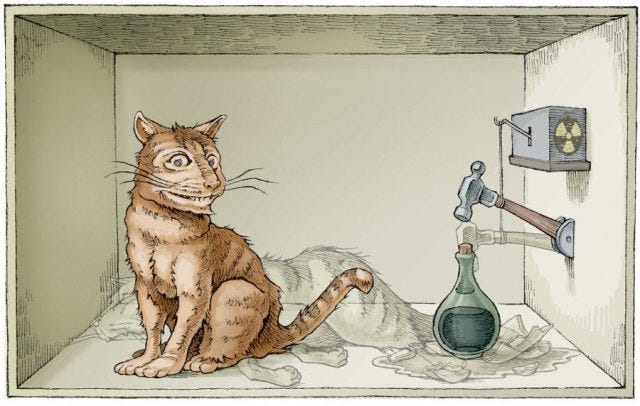
What if you’re the happiest when you’re not checking?
What’s interesting about psychologists is that investigating one’s mind too much is known to be associated with negative mood.
That is, like a kind of nocebo effect, turning your attentional camera away from external reality and inwards towards the mind too much may make you unhappy.

There’s data that making happiness into a goal just makes people miserable, because ‘failure’ to achieve that happiness leads to rumination. That is, by making happiness the goals, you’ve set yourself up to get another hit of misery when something goes bad. You get the initial hit of disappointment from whatever made you unhappy, and then you get even more misery from thinking about how you’re failing at being happy.
Let’s break this down more:
Excessive self-focus is associated with negative mood and anxiety.
In fact, a core symptom of depression is rumination i.e. excessive thinking about one’s problems.
Self-rumination* is associated with neuroticism and trait neuroticism has been found to be associated with reports of depressive symptoms.
Putting his political commentary aside, Dr. Jordan Peterson has a PhD in clinical psychology and taught at Harvard. He’s explained that:
“there is no difference between thinking about yourself and being miserable. They load on the same statistical axis.”
A 2009 study highlights the default mode network as a key self-referencing part of the brain and that depression may induce an inability to reduce activity in the self-referencing default mode network.
The flip side is also true: directing your attention towards the external world and maintaining a focus on a task is associated with happiness.
Psychologist Mihaly Csikszentmihalyi argues that Flow is the “secret to happiness.” Flow is essentially the opposite of rumination and/or mind wandering - your mind is completely and utterly immersed in a task to where no bandwith is left to even do any mind wandering or self referencing.
*Note that some amount of focus on the self for the purpose of reflecting on one’s behavior in order to improve it can be good for wellbeing.
What do these points say about psychology?
After reading about Schrodinger’s cat, the cat that is simultaneously alive and dead while unobserved, Tom looks up from his phone and out the window to see the beautiful day he’s missing. The weather is nice and cool so he decides to hit the trails with his mountain bike.
In under an hour, Tom finds himself barreling down a mountain on their mountain bike. He’s moving so fast that his focus has become razor sharp - not by his own power of will, but because if he got distracted for a second, he’d need reconstructive surgery on his face after crushing it into a tree. He’s become so focused on the trail, his bike and the trees that that nothing else exists. There’s no mental processing left for a sense of “I,” he’s in total flow which means he doesn’t even realize that there is an “I” in flow. After the trail finally levels out, he finds himself back in his body and his inner narrator comes back online. “Wow, what a rush.”
Here’s the question: During the bike run, could Tom be unhappy?
That is, if Tom is near ego death-level absorbed in something and unable to even have thoughts about how he’s feeling, is he even capable of being unhappy?
So again:
What if the act of investigating the mind was not a neutral process at all, and the act of observing the mind leads to biased the assessments of the contents of the mind?
・If simply turning one’s attention away from the external world and towards the mind itself too much made people unhappy?
・Wouldn’t that mean gloomy ‘revelations’ about the mind could have been biased to being that way?
Gloomy psychology
Gabor Mate claims that investigation into the mind will reveal that all people have trauma. Freud said that the mind is filled with dark “repressed emotions” tucked away into your subconscious (that he needs to talk out of you).
While not all, many respected thinkers, philosophers and psychologists are often quite pessimistic and dark.
Existentialist Philosophy Jean-Paul Sartre argued that most of our anguish comes from relations with other people, famously saying:
“Hell is other people.”
Albert Camus said:
“There is but one truly serious philosophical problem and that is suicide. Judging whether life is or is not worth living amounts to answering the fundamental question of philosophy.”
Nihilist philosopher Emil Cioran wrote:
"It is not worth the bother of killing yourself, since you always kill yourself too late."
Freud of course came up with all kinds of odd theories about the mind including ‘everyone wants to bang their Mom …and if they say they don’t, that’s repression.’ He also said in a 1918 letter to Oskar Pfister that:
“I do not break my head very much about good and evil, but I have found little that is 'good' about human beings on the whole. In my experience most of them are trash…”
Of course the original blackpiller Arthur Schopenhauer wrote that:
“The best consolation in misfortune or affliction of any kind will be the thought of other people who are in a still worse plight than yourself; and this is a form of consolation open to every one. But what an awful fate this means for mankind as a whole! We are like lambs in a field, disporting themselves under the eye of the butcher, who chooses out first one and then another for his prey.”
How often are these dark ‘revelations’ about the mind the result of too much rumination?
P.S. Some of Freud’s revelations may have been the product of his cocaine addiction.
I find this and your previous article interesting, for I provide hypnotherapy, which does indeed dig deep to find the root cause of issues - and gets rid of them in doing so.
In contrast, normal therapy seems to be just sitting around discussing how awful the problem is, how awful it makes you feel, and so isn't it just so awful? I fail to see how that is helpful.
I think this is my main concern about people using AI for therapy. The AI will just agree it's terrible, congratulate you on being so strong as to stand it, and ask if you'd live to delve deeper into some solutions for your terrible problem? It will then give you the cookie-cutter BS you already knew and which doesn't work. So you tell it how you failed, and it congratulates you for being so strong as to admit you're a failure, and how that's not failing, that's the first step to success! Rinse and repeat, spiralling into a pit of despair, until you look up at the monitor when it says something that makes no sense, and realize you're actually alone, talking to code.
Eww.
Great article as always WIL, keep up the good work!
There are videos made by Dr. K from HealthyGamerGG titled "I feel like I have no purpose" and "Processing Emotion". He argued that if you want to find purpose in your life, you have to focus inward yourself rather than external world, therefore some "silence" like walking in nature, commuting, doing chores, or going to toilet without distraction is necessary. It's like "Shower Thought", some people find wild ideas when they are showering.
Focussing to external stimuli like playing video games, scrolling social media, watching cat videos, suppress our internal signals. We actively numb ourselves. "Silence" and boredom is useful to un-numb oursevles so that we can reconnect to our internal signals and find our purpose. He also said often times the first part of internal thought arise in negative way.
I would like to know your opinion on these videos as both contradict your article at some degree. Perhaps there is a balance between "Flow" and "Self-introspection".